If you are a small business owner, marketing can feel frustratingly slow.
You improve the website. Refine the messaging. Post more consistently. Invest in SEO, social media or ads. Then you wonder why results still feel patchy.
The reality is that marketing results rarely appear all at once.
For most small businesses, they build step by step. And before visibility really starts to pay off, there is usually an earlier stage that gets overlooked: clarity and consistency.
If your offer is unclear, your messaging is muddled, your website is underperforming or your marketing feels disjointed, pushing harder on promotion can simply amplify the problem.
That is why small business marketing often works best in this order: clarity and consistency first, then visibility, recognition, trust, enquiries, conversions and momentum.
For many businesses, this is also where outside support starts to make sense. You may not need a full in-house team, but you may need the kind of joined-up thinking a freelance marketing consultant for small businesses, outsourced marketing manager or part-time marketing department can bring.
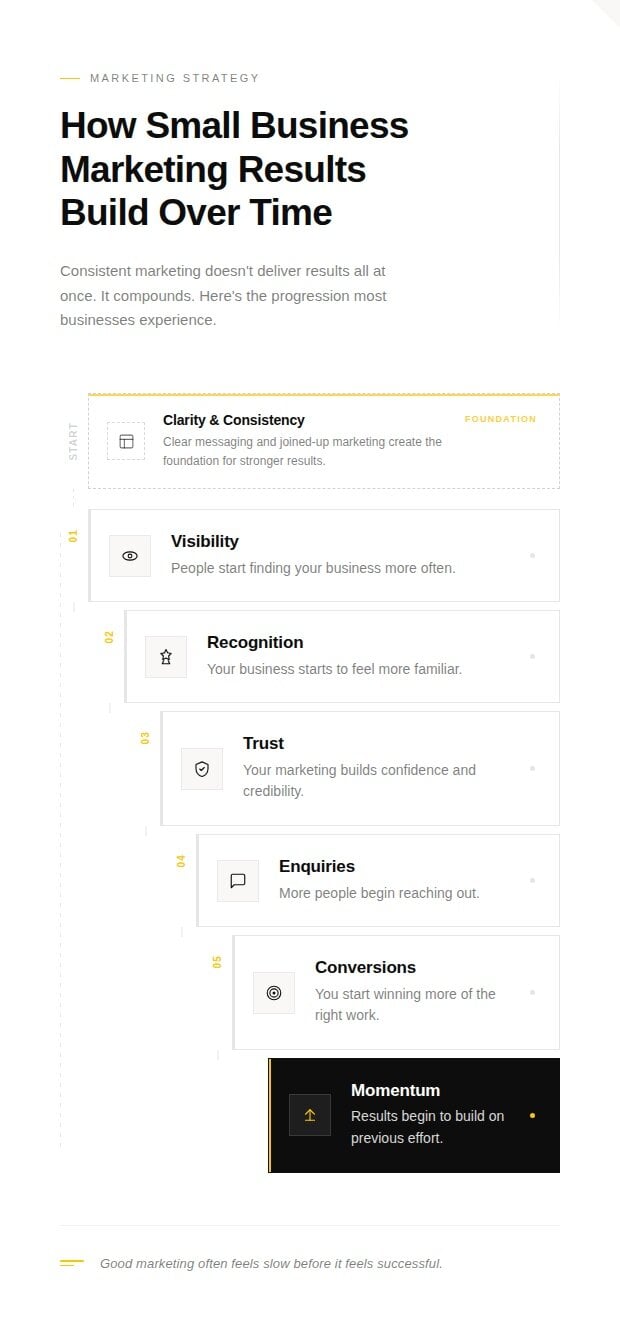
1. Clarity and consistency come first
This is often the stage that takes longer than business owners expect.
Before you throw more effort into SEO, Google Ads, social media or lead generation, it is worth stepping back and asking some basic questions. Is your offer actually clear? Do you know who you are trying to attract? Does your website explain what you do well enough? Does your marketing feel joined up across your pages, platforms and campaigns?
This matters because unclear marketing does not usually improve just because more people see it. More often, it just means more people bounce, hesitate or fail to convert.
For me, this is often where a lot of the early work sits. Tightening the message. Refining the offer. Improving the website. Simplifying the customer journey. Making sure the activity is consistent enough to support proper growth.
It is also often worth taking a step back and doing some real strategising here. That can sharpen your objectives, uncover gaps and sometimes reveal better ways to reach the outcome you actually want. A framework like SOSTAC can be useful because it helps bring structure before tactics take over.
This is also where a brand marketing consultant can make a real difference. Before chasing more traffic, it is often worth making sure the brand message is clear, the offer is compelling and the business is presenting itself consistently enough to build trust.
2. Visibility
Once the foundations are stronger, visibility becomes much more valuable.
This is where more people start discovering your business through search, social media, referrals, local marketing, PR, Google Business Profile activity, content or paid campaigns.
At this stage, results can still feel modest. You may notice more website visits, better reach or more impressions before you see a real rise in leads. That does not necessarily mean the work is failing. It often means the earlier part of the process is doing its job.
It is also worth being realistic about budget and competition. If your budget is small, your results are likely to be smaller too, especially in competitive sectors where larger businesses already have stronger visibility, more content, more ad spend and more internal marketing resource. That does not mean smaller businesses cannot stand out or do well. They can. But expectations do need to be sensible. In a crowded market, progress may be slower and harder won.
Small business owners often expect results from a website before enough people have even seen it. If your website converts at 1% to 3%, then 100 visitors might only generate 1 to 3 enquiries. Even 500 visitors may only bring in 5 to 15. So if traffic is low, results can feel underwhelming very quickly, even when the website and marketing are moving in the right direction.
3. Recognition
After visibility comes familiarity.
People start to recognise your business name, your offer, your tone of voice or your branding. They may not enquire immediately, but they are more likely to remember you later.
This stage is easy to underestimate, but it matters. People usually need to come across a business more than once before they feel ready to explore it properly. They might see your website once, notice you again on LinkedIn, come across your Google Business Profile, read a blog post later and only then decide to have a proper look.
For small businesses, recognition is often the bridge between being visible and being taken seriously.
4. Trust
Trust is where marketing starts doing more than attracting attention.
A clearer website, better copy, testimonials, case studies, useful content and a more professional overall presence all help reassure potential customers that your business is credible and worth contacting.
This is often the point where better-fit enquiries start to appear, because people are no longer just noticing you. They are starting to believe in what you do.
For many small businesses and SMEs, trust is also built by consistency. When the website, messaging, visuals and customer experience all feel aligned, the business feels more solid and more reliable.
5. Enquiries
As clarity, visibility, recognition and trust improve, more people begin reaching out.
That might show up as phone calls, emails, contact forms, quote requests or booked discovery calls.
But enquiries do not depend on marketing alone. They are also heavily influenced by how attractive, distinctive or desirable the actual product or service offer is. This is where many small business owners get caught out. They assume they know what the market wants, or they assume better marketing will automatically fix a weak offer.
Sometimes it will not.
Marketing can help a strong offer travel further. It can sharpen the message, improve visibility and help the right people understand the value. But it cannot magically make an unappealing offer compelling. If the product or service does not solve a clear problem, is not better, more relevant, more convenient, more distinctive or better priced for the market you are targeting, there may simply be limited appetite for it.
That can be a difficult truth, but it matters. Sometimes the real issue is not the marketing. It is that the offer itself needs work.
6. Conversions
Good marketing is not just about getting more leads. It is about helping you win more of the right work.
When your positioning is clearer and your marketing attracts better-fit people, conversion usually improves too. You may notice better quality enquiries, fewer time-wasters and more of the kind of work you actually want.
This is also where practical things matter. A better website, clearer calls to action, faster follow-up and a stronger sales process can all make a real difference.
7. Momentum
This is where previous effort starts to compound.
Your content keeps working. Your website continues attracting visitors. Referrals increase. Repeat business becomes more likely. Selling gets easier because the groundwork has already been done.
Momentum is also shaped by how well everything has been put in place, tested and improved over time. The stronger the foundations, the better the message, the clearer the offer and the more joined-up the activity, the more likely it is that the system starts working as a whole.
This is also where there is a real element of trying and testing things. Every business is different. Every business sits in a different competitive context, has different strengths and faces different obstacles. Some marketing mechanics will work better for some businesses than others. In some cases, certain channels, ideas or a greater degree of creativity may be worth testing. In others, simpler, steadier activity may be the better route.
Some marketing activity also works faster than others. Paid ads can create traction more quickly, while SEO usually takes longer but can build into something more durable over time. The important thing is not doing everything. It is improving the parts that move the business forward, trying new things where sensible and being honest about what is not working.
It is also worth remembering that marketing delivery depends on collaboration. A marketing professional will often need access, information, feedback, approvals or action from the business owner to keep work moving properly. If those things are delayed, that usually affects pace, delivery and results. The best outcomes tend to happen when there is openness on both sides and a willingness to work together properly.
Why small businesses give up too early
One of the biggest problems with marketing is that the early stages do not always feel dramatic.
If you are still fixing clarity, improving consistency, strengthening the website and building trust, you may not yet see a huge jump in enquiries. That can make it tempting to assume nothing is working.
In reality, those earlier layers are often exactly what make stronger results possible later.
What helps marketing results build faster?
There is no magic shortcut, but some things make a real difference:
- clearer messaging
- a stronger offer
- a better website
- joined-up marketing activity
- stronger calls to action
- testimonials and proof
- consistency over time
- regular review and improvement
In other words, better results usually come from stronger foundations.
Final thought
Good marketing often feels slow before it feels successful.
That does not mean you should keep doing things that clearly are not working. But it does mean many worthwhile marketing improvements need time to build, especially when the first step is not getting seen more but getting clearer first.
For small businesses, the goal is rarely instant transformation. It is building the right foundations, improving what matters and giving the work enough time to gain traction. When clarity and consistency are in place, the later results are far more likely to follow.
If your marketing feels slow at the moment, it may not be time to do more. It may be time to get clearer first.
I help small businesses and SMEs build clearer, more joined-up marketing so that visibility, trust, enquiries and results have a much stronger foundation. If that sounds like what your business needs, get in touch.
FAQs
Why does small business marketing take time?
Because results usually build in stages. Before more enquiries happen, many businesses need clearer messaging, stronger consistency, better visibility and more trust.
What should come before visibility in marketing?
For many small businesses, clarity and consistency should come first. If the offer, message or website is unclear, more visibility may not translate into better results.
Is it worth doing marketing strategy before tactics?
Yes. Taking a step back to review your situation, objectives and options can lead to clearer priorities and better decisions.
Do all marketing tactics work equally well for every business?
No. Different businesses have different audiences, budgets, competition levels and challenges. Testing and refining the right mix is usually part of building better long-term results.
Why might marketing not have worked in the past?
Sometimes the issue is not the channel itself. It may be the messaging, creative, budget, timing, offer or market conditions. That is why it is worth keeping an open mind rather than ruling something out too quickly.
Why does collaboration matter in marketing?
Because delivery often depends on access, information, approvals, feedback and action from the business owner as well as the marketing professional. Delays on either side can affect pace and results.