
The quick, practical guide to funding the next step (people, kit, premises, systems and the marketing foundations that actually work)
If you’ve ever typed “small business grants Kent” into Google, it usually means one thing: you can see what needs doing next, but you’d rather not fund it entirely from cashflow (or take on a loan without being 100% sure it’ll pay back).
I’m Catherine, a Small Business Marketing Consultant based in Kent, with small business clients across the UK. I work with both startups and established small businesses (many service-based) that are trying to grow without taking unnecessary risks. One of my clients – Cottage Farms, a fruit-packing client based in the borough of Tunbridge Wells, has been speaking to me about needing to explore new machinery following a successful lead generation campaign I developed for them. This prompted me to look into Kent County small business grants – and I thought the information would be useful to other small business owners in Kent.
Read on if you’d like to know what funding is realistically for, what “marketing funding” really means in grant-land, and where to look locally (without going round in circles).
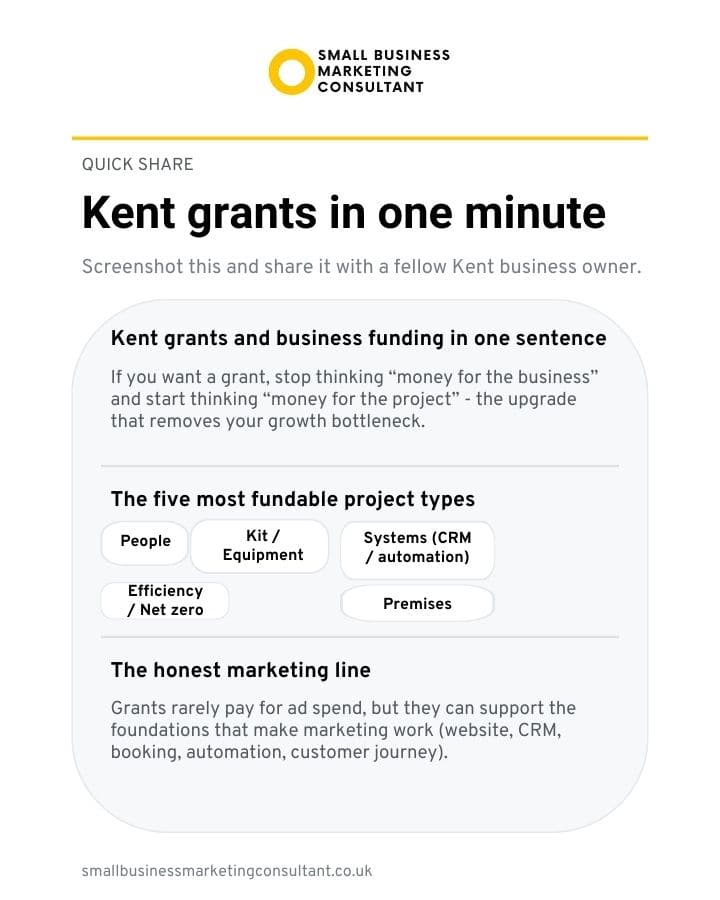
Kent grants and business funding in one sentence:
If you want a grant, stop thinking “money for the business” and start thinking “money for the project” – the upgrade that removes your growth bottleneck.
The five most fundable project types:
People • Kit/Equipment • Premises • Systems (CRM/automation) • Efficiency/Net Zero
The honest marketing line:
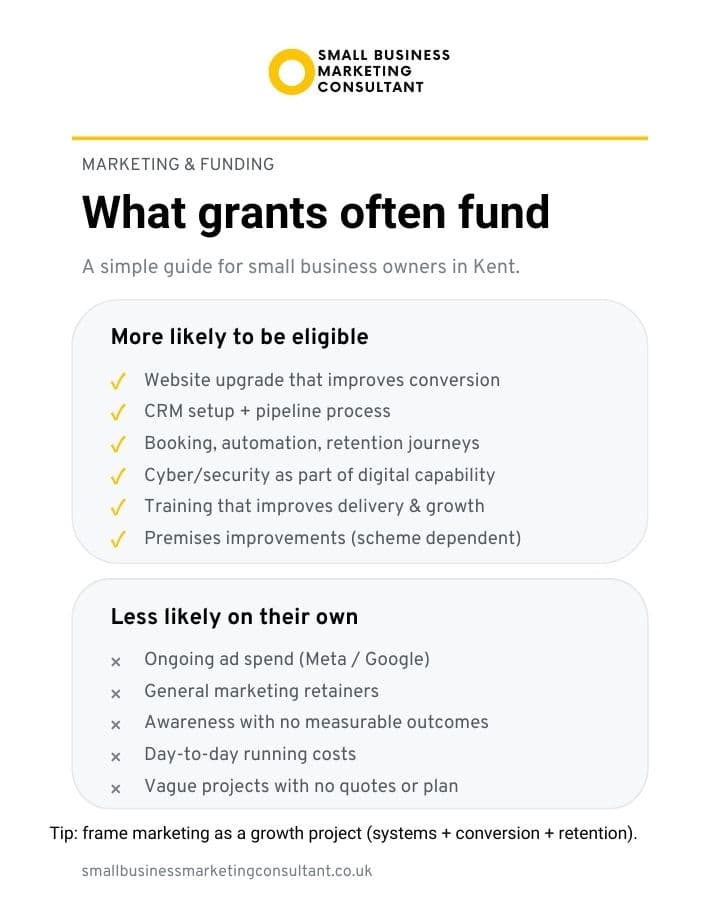
Grants rarely pay for ad spend, but they can support the foundations that make marketing work (website, CRM, booking, automation, customer journey).
Why established Kent businesses look for grants (the 5 real reasons)
1) Growth is there… but capacity isn’t (people)
You’re getting enquiries, you’re busy, but growth has hit a ceiling. The business needs extra hands, better training, or smarter delivery systems so you’re not constantly firefighting.
Typical projects: training, recruitment support, onboarding, management training, productivity improvements.
What to say in a funding application: “This investment increases capacity, improves service delivery, and supports growth.”
2) You need to invest in kit or equipment
“Equipment” isn’t just manufacturing machinery. In a service business, it can mean the tools that let you deliver faster and better: upgraded hardware, specialist tools, better customer systems, or improved security.
Typical projects: equipment upgrades, operational tools, tech that reduces errors and admin.
3) Premises are limiting what you can do (space, fit-out, accessibility)
This is a big one in Kent, especially around high streets and local centres. Your premises might be holding back footfall, customer experience, staff workflow, or simply the ability to add capacity.
If you’ve searched “funding for business premises improvements Kent”, you’re often looking for local authority schemes (sometimes linked to town centre improvements or regeneration) that open for a period and then close once funds are allocated. You’ll see examples of this style of support in local council pages such as Maidstone and Ashford.
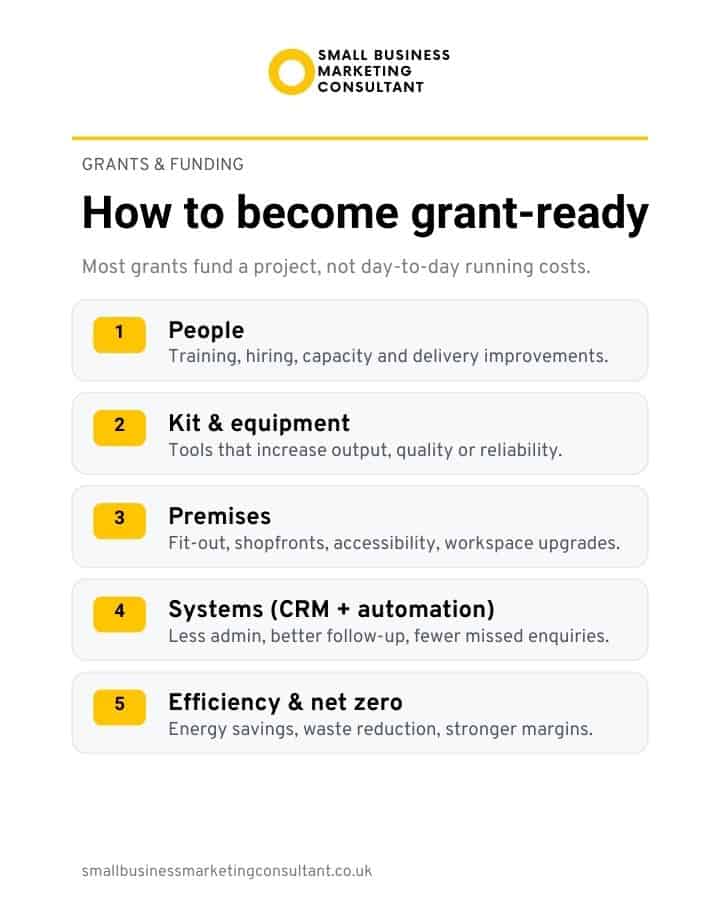
4) Systems are creaking (CRM, booking, admin, customer follow-up)
This is the “quiet” growth killer in established SMEs. You can be profitable and still haemorrhage time.
People often search “grant for CRM small business” because the real pain is:
- missed follow-ups
- enquiries not tracked properly
- inconsistent quotes
- diary gaps and cancellations
- no real pipeline visibility
This is also where you’ll see phrases like “digital adoption grant small business” – because funding bodies love “productivity” and “digital capability”.
5) Costs have gone up and margins are tighter (efficiency, energy, net zero)
Sometimes growth isn’t about more leads. It’s about protecting profit: less waste, less admin, lower energy costs, smoother delivery.
Some councils explicitly signpost “greener business” funding routes (Canterbury is a good example).
Where marketing fits into grants
Let’s get this out of the way:
Most grants don’t fund “ads”
It’s unusual to get funding purely for digital advertising campaigns in Meta or Google, or ongoing marketing retainers.
I’ve come across a couple that might do, but they offer smaller amounts…Grow in Gravesham Business Grant and Partners for Growth grant in Medway.
But many funding routes do support the marketing foundations that create growth
This is where service businesses (and lots of Kent businesses) can do well.
If you’re looking for business funding Kent and marketing is part of your growth plan, the more fundable “marketing-shaped” projects usually look like this:
- a website rebuild that improves enquiries and conversion (not just “a refresh”)
- adding proper enquiry capture and tracking
- CRM setup and pipeline process (so no leads fall through the cracks)
- booking systems, automation, reminders, rebooking journeys
- customer retention systems (email/SMS journeys)
- improving your customer experience end-to-end
If you’re applying for funding and the project includes a website upgrade, the quickest win is getting the plan, costs and outcomes straight. This is often the point where people decide to hire a marketing consultant or bring in a freelance marketing specialist to sense-check what’s realistic, what’s fundable, and what will actually drive growth. I’ve done this in practice: I helped a client understand and price up the real costs of a completely new ecommerce website so she could apply for grants and loans, and then I went on to build the website with her once the funding route was clear.
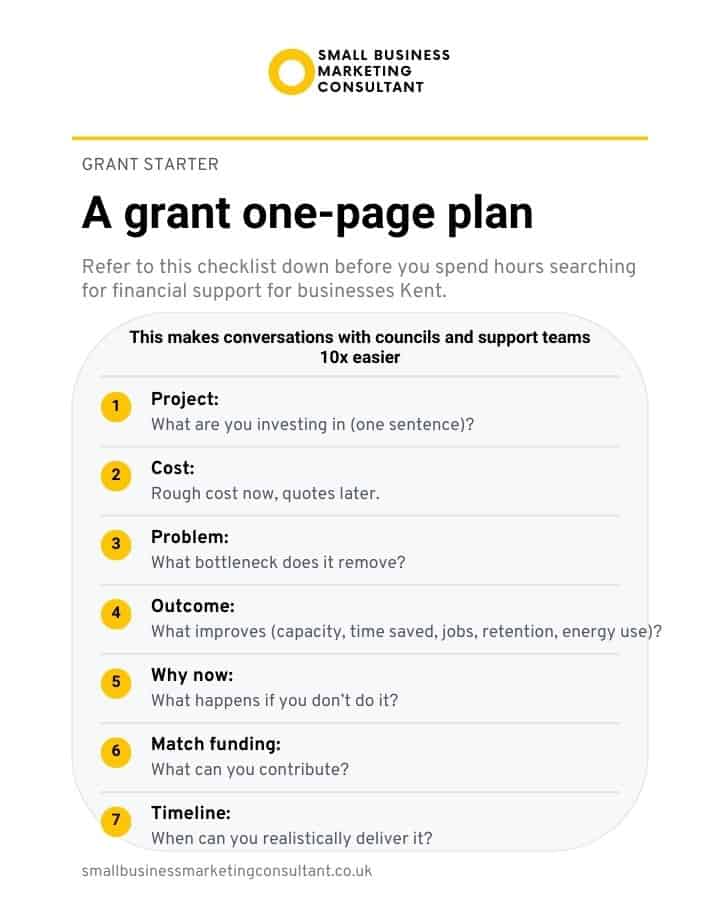
A grant one-page plan (I have included a useful illustration above that you can share)
Before you spend hours searching for financial support for businesses Kent, write this on one page:
- Project: What are you investing in (one sentence)?
- Cost: Rough cost now, quotes later.
- Problem: What bottleneck does it remove?
- Outcome: What improves (capacity, time saved, jobs, retention, energy use)?
- Why now: What happens if you don’t do it?
- Match funding: What can you contribute?
- Timeline: When can you realistically deliver it?
That little one-pager makes conversations with councils and support teams 10x easier.
Kent grants and business funding resources by area
Funding pots open and close frequently. So, the smartest approach is:
- Local council pages
- Kent-wide signposting (Growth Hub / KCC)
- West Kent support programmes (where relevant)
Maidstone
- Maidstone Borough Council business and investment support
- Shopfront improvement grant info (Maidstone)
- Maidstone Rural England Prosperity Fund guidance (REPF)
- Kent & Medway Growth Hub: Maidstone support Kent & Medway Growth Hub
- Kent County Council: business loans and funding Kent County Council
Ashford
- Ashford Borough Council: business grants and funding
- Ashford Town Centre business grants
- Ashford REPF grants (Rural England Prosperity Fund)
- Kent & Medway Growth Hub: Ashford support Kent & Medway Growth Hub
- Kent County Council: business loans and funding Kent County Council
Tonbridge (Tonbridge & Malling)
- TMBC: apply for business grants tmbc.gov.uk
- TMBC: start and grow your business support tmbc.gov.uk
- Invest West Kent business support Invest West Kent
- West Kent Business grants programme (micro grants / small business support where open) West Kent Business
- Kent County Council: business loans and funding Kent County Council
Tunbridge Wells
- Tunbridge Wells Borough Council: funding for businesses tunbridgewells.gov.uk
- Tunbridge Wells business support hub tunbridgewells.gov.uk
- Grants for business decarbonisation (Tunbridge Wells) tunbridgewells.gov.uk
- West Kent Business support and grants West Kent Business
- Kent & Medway Growth Hub Kent & Medway Growth Hub
Sevenoaks
- Sevenoaks District Council: business support and grants Sevenoaks District Council
- Sevenoaks District Council: support schemes for your business Sevenoaks District Council
- Kent & Medway Growth Hub: local support in Sevenoaks Kent & Medway Growth Hub
- West Kent Business grants programme West Kent Business
- Kent County Council: business loans and funding Kent County Council
Canterbury
- Canterbury City Council: business and investment canterbury.gov.uk
- UK Shared Prosperity Fund (Canterbury) canterbury.gov.uk
- Funding to make your business greener (Canterbury) canterbury.gov.uk
- Kent & Medway Growth Hub: local support in Canterbury Kent & Medway Growth Hub
- Kent County Council: business loans and funding Kent County Council
Kent-wide (bookmark these)
- Kent & Medway Growth Hub (advisers + signposting to grants and programmes) Kent & Medway Growth Hub
- Find local business support by area (Growth Hub) Kent & Medway Growth Hub
- Kent County Council: business loans and funding (includes Kent & Medway Business Fund routes) Kent County Council
A quick note on “loans vs grants” (because it matters)
Some of the most useful “funding” in Kent is not a grant – it’s a loan, a match-funded programme, or a funded support scheme with a small contribution.
FAQs
Sometimes, but usually not for advertising spend on its own. Funding is more often available for the foundations that make marketing work, such as website improvements, ecommerce or booking upgrades, CRM implementation, automation, and training that improves conversion and retention.
It’s uncommon. Some schemes may allow limited promotional activity as part of a wider business improvement project, but ongoing ad spend is rarely eligible. If you’re applying, position the work as digital capability, customer journey improvement, or productivity rather than “we need ads”.
It usually means support to improve how your business runs using digital tools. Think CRM, booking systems, job management, ecommerce, customer communications, cyber security, and automation – with a focus on productivity, customer experience, and scalable delivery.
It can be, especially if the CRM is part of a wider project to improve productivity and customer management. Not every scheme funds software, but many support digital improvements where you can show measurable outcomes, such as time saved, improved conversion, or improved retention.
It often relates to upgrades that improve a customer-facing space, shopfront, accessibility, fit-out, or bringing a vacant unit back into use. These are commonly linked to regeneration or place-based funding. The key is to show how the improvement supports growth, footfall, or long-term viability.
Very often, yes. Many schemes share the cost rather than paying for everything. You may need to contribute a percentage and claim the grant against eligible spend. Always check whether the funding is capital-only, whether VAT is included, and if there’s a spend-by deadline.
A clear project summary, costings or quotes, basic financial information (often recent accounts), proof of location, and a simple explanation of outcomes. Outcomes can include jobs created or safeguarded, productivity improvements, increased capacity, reduced energy use, or improved customer retention.
Start with official sources: your borough council, the Kent & Medway Growth Hub, and Kent County Council funding pages. Be cautious of anyone promising guaranteed approval, pushing large upfront fees, or pressuring you to share sensitive data early. If in doubt, ask a council or Growth Hub adviser to sense-check it.
If you’re a small business owner in Kent and you’re ready to hire a marketing consultant, together we can have a look at whether there are any grants that make sense for you to explore, whilst I deliver on ongoing marketing work.
If you want a freelance marketing consultant who’ll partner with you long-term and focus on results – enquiries, conversion, retention and systems that save time – get in touch today.