For many small businesses, a marketing consultant or freelance marketing consultant is often the most flexible first step, especially if you need senior thinking, practical delivery and help deciding what to prioritise before committing to an agency or full-time hire.
If you run a small business, there often comes a point where you know your marketing needs more attention, but you’re not quite sure what kind of help you actually need.
Should you hire a marketing agency?
Should you work with a freelance marketing consultant?
Should you bring someone in-house?
Or do you simply need some practical marketing advice before you commit to anything bigger?
There’s no single right option. It depends on where you are now, what you’re trying to achieve, how much support you need, and whether you need strategy, delivery, or both.
For many small businesses, micro businesses, start-ups and SMEs, the best first step isn’t always a large agency or a full-time hire. Often, what’s needed first is a clearer view of what’s working, what isn’t, where the missed opportunities are, and what should happen next.
That’s where a marketing consultant, freelance marketing consultant or outsourced marketing support can be especially useful.
In this guide
- The quick answer
- Marketing consultant vs agency vs in-house: a simple comparison
- What does a marketing consultant do?
- What does a marketing agency do?
- What about hiring someone in-house?
- What is outsourced marketing support?
- When is a marketing consultant the best choice?
- Real examples from small business marketing work
- Consultant vs agency: which is more cost-effective?
- Questions to ask before choosing marketing support
- FAQs
The quick answer
If you need senior marketing thinking, practical support and flexibility, a marketing consultant or freelance marketing consultant for small businesses can be a very good fit.
If you need a larger team, specialist services at scale, or lots of regular campaign production, a marketing agency may be the better option.
If you have enough work, budget and internal management time to support a permanent role, hiring someone in-house may make sense.
But for many small businesses, the real issue isn’t simply that they need “more marketing”. They need clearer priorities.
I see this often. A business owner may be thinking about their website, SEO, Google Ads, social media, blogs, emails, reviews, PR and LinkedIn all at once. Everything feels important, so it becomes difficult to know where to start.
In reality, good marketing isn’t about doing everything. It’s about doing the right things, in the right order, for the right audience.
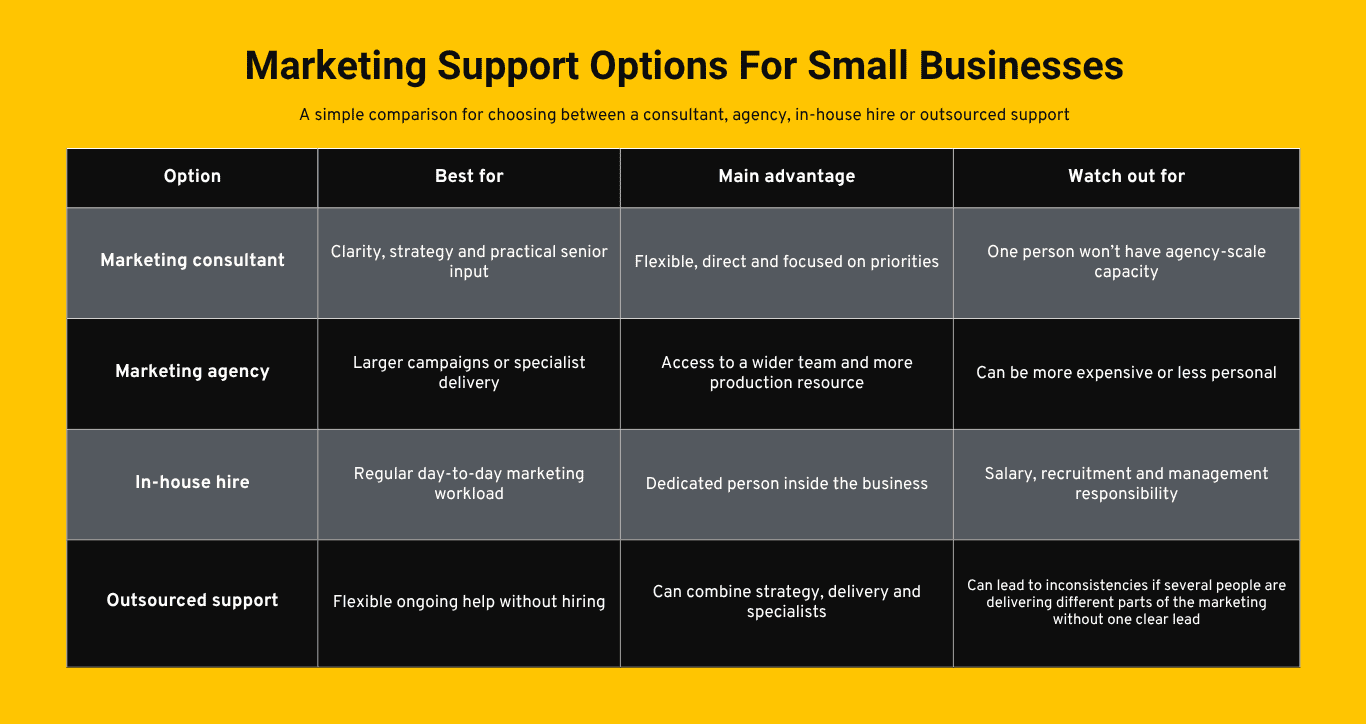
A simple way to think about it is this:
Choose a marketing consultant if you need clarity, senior thinking, flexibility and practical support.
Choose a marketing agency if you need a larger team, more delivery capacity, or several specialist services working together at pace.
Choose an in-house marketer if you have enough regular work, budget and management time to justify a permanent role.
Choose outsourced marketing support if you want flexible help without hiring permanently but make sure someone is leading the overall direction.
What does a marketing consultant do?
A marketing consultant helps a business decide what marketing activity is worth doing, how to do it properly, and in many cases, helps to deliver the work too.
That might include reviewing your website, improving your messaging, helping with SEO, planning and writing content, setting up or improving Google Ads, improving social media, looking at email marketing, or helping you understand where your leads are coming from.
Some marketing consultants focus mainly on strategy and advice, while others also get involved in practical execution. But the most useful part often isn’t just the individual task. It’s the thinking behind it.
A good marketing consultant should help you answer questions such as:
Who are we trying to reach?
What are they actually searching for?
Is our website clear enough?
Are we making it easy for people to enquire?
Which marketing channels are worth our time?
What should we stop doing?
What should we do first?
Some businesses need a marketing consultant to guide an internal team or agency. Others need someone more hands-on who can help write the pages, improve the content, plan the campaign, brief the designer, review the ads, check the analytics and keep the work moving.
For many small businesses, that combination of advice and execution is what makes the support useful. Good marketing help for small businesses isn’t about making everything more complicated. It’s about helping you focus and then move the right things forward.
What does a marketing agency do?
A marketing agency usually offers a team of people who can deliver different parts of your marketing. Depending on the agency, that might include branding, web design, SEO, paid ads, social media, PR, content, email marketing or graphic design.
This can be very useful if you have a bigger budget, a clear brief and enough work to justify a team. An agency might be the right choice if you’re launching a larger campaign, need a full rebrand, want a more complex website build, or need regular design and content production across several platforms.
A good agency may also bring established processes, reporting systems, creative review, account management and continuity across a team, which can be helpful when there is a lot of work to deliver at pace.
For a small business, the main question is whether you need that level of resource yet.
An agency can bring a lot of value, but it may also involve a larger investment, a longer commitment and more moving parts than the business is ready for. You may be asked to commit to a fixed monthly retainer before you’re completely clear on what you need, or you may deal day-to-day with an account manager rather than the senior person who originally scoped the work.
There can also be less flexibility. With an agency, you may agree a set package of work, a particular scope, or a defined way of working. If your priorities change, it can take time to revisit the brief, change direction, or agree a new cost.
With a marketing consultant, the support can often be more flexible, proactive and reactive. You might start by thinking you need more social media content, but then realise the website isn’t converting, the Google Business Profile needs work, or the customer journey is unclear. A flexible consultant-led approach can make it easier to respond without having to start again.

What about hiring someone in-house?
Hiring someone in-house can work well when your business has a steady flow of marketing tasks and someone internally who can manage that person properly.
An in-house hire can get to know your business deeply and become a valuable part of the team. However, one in-house person can’t usually do everything.
A junior marketing executive may be great at social media and admin but may not have the experience to lead strategy. A more experienced marketing manager may be able to lead the work, but the salary cost will be higher.
There’s also the question of management. If you don’t know what marketing activity should be happening, it can be difficult to brief, support and judge the performance of an in-house marketer.
This is why some small businesses benefit from working with a marketing consultant first, even if they later decide to hire someone permanently.
What is outsourced marketing support?
Outsourced marketing support is when you get external marketing help without employing someone permanently.
That support might come from a marketing consultant, a freelance marketer, a small agency, or a mix of trusted specialists.
Some small businesses choose to work with separate specialists. For example, they might have one person helping with social media, another helping with SEO, another supporting branding, and perhaps someone else helping with website development or paid ads.
There can be real advantages to this. A specialist is likely to spend most of their working time focused on one particular area. They should be keeping up with changes in that field, learning from other client work, and bringing a deeper level of knowledge in their specialism.
So, if you know exactly what you need, this can work very well.
The challenge comes when a small business is not yet sure what the priority should be.
If you have several different people delivering different parts of the marketing, someone still needs to hold the overall direction. Otherwise, the work can become inconsistent, even when each person is doing a good job in their own area.
It’s also worth understanding who is actually doing the work. Sometimes the person you speak to is managing or reselling work delivered by someone else. That can still work well, but it can create a gap in accountability if the business owner doesn’t know what to ask, and the person managing the relationship isn’t close enough to the detail.
The social media might look good but not quite match the website. The SEO work might bring in more traffic, but the message may not convert. The ads might generate clicks, but the customer journey may not be strong enough to turn those clicks into enquiries.
That’s why outsourced marketing support works best when there is one clear lead. Someone needs to look across the whole business, understand the brand, manage the priorities, and make sure the different parts of the marketing are working together.
For many small businesses, it’s not always realistic for the owner to manage several separate marketing specialists, especially if they don’t feel confident judging the work or knowing what should happen next.
This is where a consultant-led approach can be useful. You can still bring in specialists when they’re needed, but there is someone holding the overall plan together and making sure the work stays consistent, focused and useful.
When is a marketing consultant the best choice?
A marketing consultant can be the best choice when you need experience, flexibility and practical support without committing to a full agency package or a permanent salary.
This can work particularly well if you’re a small business owner who knows your marketing needs improving, a micro business or start-up needing clear direction, an SME without a marketing department, or a business that has tried bits of marketing but lacks a proper plan.
A marketing consultant for small businesses can also be useful when you have lots of ideas, but no clear order of priority.
You may be thinking about SEO, social media, email marketing, Google Ads, PR, LinkedIn, website changes, blogs, reviews and local visibility all at once.
The problem is that most small businesses don’t have unlimited time or budget. So, the question isn’t “could we do this?” The question is “is this the best use of time and money right now?”
That’s where an experienced consultant can help.
You don’t always need to commit to a long contract. Sometimes the first step is a one-off review, consultation or short project, so you can get an experienced outside view on what’s working, what isn’t working, and what could be improved.
A real example: when the website has to come before more marketing
This is where a broader marketing consultant view can be useful.
Sometimes a business owner may think they need more marketing activity, when the real issue is that the foundations aren’t strong enough yet. If they brief a social media specialist, they may get better social media. If they brief a Google Ads specialist, they may get ads. If they brief an agency on a specific campaign, they may get that campaign.
But if nobody steps back and looks at the business as a whole, the real issue can be missed.
That was the case with Cottage Farms, a fruit packing and ripening business in Kent.
Cottage Farms is an established business working with major retail and trade customers, including Tesco, but the old website didn’t really show that. It didn’t reflect the scale of the company, the quality of the operation, or the kind of buyers they wanted to reach.
As a small business marketing consultant, my role was not just to “do more marketing”. It was to work out what needed to happen first.
In this case, that meant repositioning the business properly online and coordinating a new website project with trusted collaborators. The work moved Cottage Farms from a basic one-page site to a more substantial website with clearer messaging, better structure, improved SEO and language aimed at the right trade buyers.
That’s a good example of why marketing support for small businesses isn’t always about doing more. Sometimes the most useful thing is to stop, look properly at what’s already there, and fix the thing that’s holding everything else back.
A real example: when wider marketing support adds more value than one isolated task
When Belle Ame first brought me in, the initial brief was fairly simple.
The salon wanted its marketing to look more professional, especially on social media. At that stage, the posts were mainly client hair photos from different stylists. There was lovely work being shown, but the content was quite repetitive, the branding was not very developed, and the captions, hashtags and wider messaging were not doing as much as they could.
If the salon had hired someone purely to manage social media, that person may well have improved the look and consistency of the posts.
But because my work looks at the whole marketing picture, the support quickly became broader than that.
Alongside improving the social media, I started spotting other areas where marketing could work harder. That included website improvements, SEO, backlinks, content ideas, Google Ads, social media advertising, Google Business Profile, PR opportunities, online booking links and the way the brand came across more generally.
That broader approach made a real difference. In her video testimonial, Lauren, Belle Ame’s owner, said that before working with me, the salon was on the “second, third page” of Google and felt “just irrelevant”. She said that since then, the salon has become “so easily accessible”, with much more presence across Google, Instagram and Facebook.
She also summed up the original aim very clearly: she wanted the salon to have “a classy feel and a cohesive feel” and to drive revenue. Her words were that I “smashed both”.
That is the difference between hiring someone to deliver one channel and working with someone who is looking at the brand more holistically.
A social media specialist might have done a good job with the posts. But they probably would not have been looking at the website, search visibility, Google Ads, PR, customer journey, online booking process and wider brand communication at the same time.
For many small businesses, that broader view is where a marketing consultant can add real value. It means the business is not just getting more activity. It is getting someone who can look across the marketing, spot opportunities and help move the right things forward.
You can watch Lauren’s video testimonial to hear more about the difference the work made to Belle Ame’s visibility and marketing.
Consultant vs agency: which is more cost-effective?
The most cost-effective option depends on what kind of support the business actually needs.
For many small businesses, a marketing consultant or freelance marketer can be a more practical starting point than a larger agency. If you need senior input, clearer priorities and hands-on support, an independent consultant can often give you direct access to experienced thinking without the structure or overhead of a larger team.
An agency may be the better investment when the business needs more capacity. For example, if you are a larger small business, a fast-growing company, or a well-funded start-up that needs rapid growth across several channels at once, an agency may have the team, systems, specialist skills and delivery capacity to move faster. It can also reduce pressure on the business owner if there are several strands of work to coordinate at the same time.
So, the question isn’t simply “which is cheaper?” It is “which is the right fit for what the business needs now?”
Cheap marketing that sends you in the wrong direction isn’t good value. But a larger investment is only worthwhile if it is genuinely helping the business move forward.
The right marketing support should help you focus on the right priorities, make better decisions and create stronger foundations for business growth and development.
If you want to understand the likely costs in more detail, I’ve also written about how much it costs to hire a marketing consultant.
Questions to ask before choosing marketing support
If you’re a small business owner, start-up founder or micro business owner, it’s worth getting more than one point of reference before you commit to marketing support.
Different consultants, freelancers and agencies may all look at the same business and suggest very different ways forward. One may recommend a large monthly campaign. Another may suggest fixing the website first. Another may focus on Google Ads, social media, SEO, PR, branding or content.
The recommendations can vary hugely, and so can the costs. One option might involve several thousand pounds a month. Another might involve a smaller, more flexible project or a few days of support spread over time.
That doesn’t automatically mean one is right and the other is wrong. It depends on the stage of the business, the available budget, the urgency of the goals and how much risk the owner is comfortable taking.
But it does mean you should not feel pressured into making a quick decision, especially if the investment feels too large or the sales process feels uncomfortable.
It’s also worth asking what kind of experience the consultant, freelancer or agency has.
Sometimes, direct experience in your industry can be very useful. If someone has already achieved good results for similar businesses, they may understand the market, the customers, the language and the common challenges more quickly.
But industry experience is not the only thing that matters. Someone coming in with fresh eyes and broader experience across different sectors can be just as valuable. They may spot opportunities that someone too close to the industry might miss, or bring experience from other areas such as business development, sales, customer journey, PR or brand positioning.
It’s also worth asking what you will own and have access to.
Whoever you work with, your business should keep control of key accounts and assets. That includes your website, domain, hosting, Google Business Profile, Google Ads, Google Analytics, Google Search Console, Meta Business Suite, Canva files, email marketing platform, photos, brand colours, passwords and logins.
I always prefer accounts and assets to be created either by the business owner or using the owner’s details, so the business has ultimate access.
I have seen what can happen when this is not done properly. A business can end up with several different Google accounts, different tools linked to different logins, missing passwords, inconsistent colours across Canva and the website, and no clear overview of where everything lives.
It may not be anyone’s intention to make things difficult, but it can create problems later. Marketing support should make your business easier to manage; not leave you locked out of your own systems or unsure who controls what.
You should also ask how progress will be measured. That doesn’t mean expecting instant sales from every activity, but there should be some agreed way of reviewing whether the work is moving the business in the right direction. Depending on the activity, that might include enquiries, bookings, website traffic, search visibility, conversion rate, ad performance, email sign-ups or stronger brand consistency.
Finally, it’s worth asking how AI tools are being used. AI can be very useful for research, ideas, drafting and speeding up some marketing tasks, but it should not replace proper thinking, brand understanding or human judgement. For a small business, the risk is not using AI. The risk is publishing generic content that does not sound like the business, does not reflect real experience and does not help the customer make a better decision.
For many small businesses, slow and steady progress can be a better fit than committing to a big monthly spend straight away. Sometimes the safer option is to get an experienced outside view, understand the priorities, and then build momentum step by step.
It helps to understand how small business marketing results build over time, rather than expecting every activity to produce instant results.
You can also read more about my background as a small business marketing consultant here and the kind of businesses I work with.
My honest view
My honest view is that many small businesses don’t need to jump straight into a big agency relationship.
Some do, of course. If you have the budget, the brief and the volume of work, a good agency can be a brilliant partner.
But many small businesses first need someone experienced to help them understand what’s worth doing.
They need someone who can look at the website, search visibility, messaging, content, advertising, customer journey and numbers, and turn that into a practical plan.
That might lead to working with a freelancer, hiring someone in-house, or bringing in an agency later.
But it starts with knowing what you actually need. Because good marketing isn’t just about doing more. It’s about doing the right things, in the right order, for the right audience.
FAQs
Is a marketing consultant better than a marketing agency?
Not always. A marketing consultant is often better for a small business that needs senior thinking, flexibility and practical advice. A marketing agency may be better if you need a larger team, specialist services or high-volume delivery.
What is outsourced marketing support?
Outsourced marketing support means getting external marketing help without employing someone permanently. For small businesses, this can be a flexible way to access marketing strategy, SEO, content, social media, advertising and practical delivery without hiring a full-time member of staff.
Is it better to use several marketing specialists or one marketing consultant?
It depends on what you need. If you know exactly what specialist support you need, such as technical SEO, branding or social media content, a specialist can be a very good choice. If you’re not sure what the priority should be, or you need the different parts of your marketing to work together, a broader marketing consultant may be more useful.
Can a marketing consultant help with SEO, content and Google Ads?
Yes, many marketing consultants can help with SEO, content and Google Ads, although the exact services will depend on their experience. For a small business, it can be helpful to work with someone who understands how these areas connect rather than looking at each one in isolation.
What should I do before hiring marketing support?
Before hiring marketing support, try to be clear on what you want to improve. Is it your website, search visibility, social media, lead generation, content, advertising or overall strategy? If you’re not sure, it may be worth speaking to a marketing consultant first to help identify the priorities.
Need practical marketing help?
If you’re a small business owner and you’re trying to work out whether you need a marketing consultant, a freelance marketer, an agency, outsourced marketing support or an in-house hire, I can help you think it through.
I work with small businesses across the UK that need clearer priorities, better visibility, more enquiries and practical marketing support without jargon, overwhelm or unnecessary complexity.
If you’d like an experienced outside view on what’s working, what isn’t, and what to focus on next, get in touch.